

Planning to move abroad?
We will arrange a comfortable and safe move for you to a new place with transportation of all your personal belongings

Floor Level in Moving
Floor level is one of the most important access details in any move. It refers to the level of the building where goods are collected or delivered and helps determine how difficult the loading or unloading process is likely to be.
For customers, floor level can sound like a simple address detail. In practice, it affects time, effort, access planning, equipment needs, and sometimes cost. The higher the floor, the more important it becomes to understand whether loading and unloading take place at street level, whether there is a suitable lift, how many stairs are involved, and whether large items can be moved through the building normally.
In international moving, floor level matters at both ends of the move. A shipment may travel smoothly over a long distance, but loading or delivery can still become much more demanding if the property is above street level and access is limited.
Why floor level can be confusing internationally
Floor numbering is not described the same way in every country or in every variety of English.
In British English, the ground floor is the level at street level, and the first floor is the level above it. In American English, first floor usually means the level at street level. That means two people can describe the same apartment differently and both be correct within their own system.
A customer in London may say “first floor” and mean one level above street level, while a customer in New York may say “first floor” and mean street level itself. Across continental Europe, the wording also varies by language, with many countries using their own local term for the street-level floor and then numbering the floors above it.
That is why, in moving, the most useful question is not simply “Which floor is it?” but “Is it at street level, one floor above street level, or higher, and how is it accessed?”
What floor level means in practical moving terms
In moving, floor level is less about the label and more about the actual route between the property and the vehicle.
What really matters is whether the property is:
- at street level
- one floor above street level
- several floors above street level
- below street level
- accessible by a suitable lift
- accessible only by stairs
- difficult to reach with large or bulky items
This is why professional move planning should never rely only on the words “ground floor” or “first floor.” The practical question is how the goods will actually travel in and out of the building.
Which countries commonly use which system
There is no single worldwide naming system for floors, and there is also no single Europe-wide everyday naming standard that overrides national usage.
In practice, the most common systems look like this:
Ground-floor system
In this system, the level at street level is called the ground floor, and the level above it is called the first floor.
This system is commonly used in:
- the United Kingdom
- Ireland
- Australia
- New Zealand
American first-floor system
In this system, the level at street level is called the first floor, and the level above it is called the second floor.
This system is most commonly associated with:
- the United States
Common continental European pattern
Across much of continental Europe, the street-level floor usually has its own local-language term rather than simply being treated as “first floor.”
Examples include:
- France: rez-de-chaussée for street level, then upper floors above it
- Spain: planta baja for street level, then numbered floors above it
Because terminology varies across Europe by language and local convention, the safest wording in international moving is often not “first floor” or “second floor,” but:
- street level
- one floor above street level
- two floors above street level
- basement or below street level
European standards and what they do not standardise
For moving purposes, it is important to separate construction standards from everyday floor naming.
European standards such as the Eurocodes deal with the structural and technical design of buildings. They do not create one shared public naming system for floors used in removals, estate listings, or everyday customer communication.
That is why floor naming across Europe still follows national language and local convention rather than one single unified European rule.
Why this matters in moving
Different naming systems can create real misunderstandings if they are not clarified early.
For example, a customer may say they live on the first floor. Depending on where they are from, that could mean:
- street level
- one floor above street level
For a mover, those are not the same thing. One may involve almost direct access, while the other may involve stairs, lift use, tighter handling conditions, and more time.
That is why access details should always be confirmed in practical terms rather than assumed from the floor label alone.
The clearest way to describe floor level
The clearest way to describe floor level for an international move is to think in relation to the street rather than relying only on local naming.
For example:
- street level
- one floor above street level
- two floors above street level
- basement or below street level
This avoids confusion between British-style, American-style, and local European systems and gives a much clearer picture of the real access conditions.
Why floor level matters
Floor level matters because it directly affects how goods are moved in and out of a property.
Loading and unloading from street level is usually considered standard access. In many cases, one floor above street level is also still relatively standard, especially if the route is simple and the items can be moved without difficulty.
Once the property is higher than that, access usually becomes a more important quoting factor unless there is a lift that is genuinely suitable for moving. The more floors involved, the more important it becomes to understand the route properly.
This becomes especially relevant when the shipment includes large furniture, heavy items, fragile pieces, or anything difficult to carry through stairs or lifts.
Why upper floors change the move
Upper floors often make a move more complex because they increase the amount of vertical transport involved.
Even with a working lift, upper-floor loading and unloading usually take more time than street-level access. Without a suitable lift, the move may depend heavily on the staircase, which can slow the process further and make the handling of larger items much more difficult.
As a general rule, street-level loading is the simplest situation. One floor above street level is also often manageable as normal access. Above that, the move is much more likely to require extra planning and additional quotation unless the building has a lift that is appropriate for moving household goods.
Staircase access matters as much as floor level
Floor level on its own never tells the full story. Staircase access can make a major difference to how difficult the move actually is.
What matters is not only how many floors are involved, but also:
- how many stairs there are in total
- whether the staircase is straight or has tight turns
- whether the landings are narrow
- whether large items can be rotated safely
- whether the stairs are steep
- whether there are obstacles, security doors, or awkward entrance angles
A second-floor move with a wide, straight staircase may be simpler than a first-floor move with a tight spiral stairwell. That is why staircase access should always be considered together with floor level.
Floor level and lift access
Floor level is closely connected to lift access, but the two are not the same.
A property may be several floors above street level but still be relatively easy to move if there is a large service lift with good access. On the other hand, a lower floor can still be difficult if the lift is too small, unavailable, or unsuitable for furniture.
For moving purposes, a lift is only truly helpful if it is suitable for household goods. A small passenger lift may reduce some carrying, but it may still be of little use for sofas, wardrobes, mattresses, or other large items.
That is why floor level should always be considered together with:
- whether there is a lift
- whether the lift is large enough
- whether it is available for move use
- whether it is a passenger lift or a service lift
- whether large items can fit inside it
- whether stairs are still needed for some pieces
- whether an external lift may be needed
Common situations where floor level becomes important
Floor level becomes especially important in situations such as:
- apartment buildings
- upper-floor flats
- buildings with no lift
- buildings with small passenger lifts only
- properties with narrow staircases
- older buildings with tight landings
- moves involving bulky or heavy furniture
- deliveries to top-floor properties
- relocations where access is different at origin and destination
The floor itself is not always the problem. Often, the difficulty comes from how the floor level interacts with the building layout, staircase access, and lift suitability.
Why floor level can affect cost
Floor level can affect cost because it changes the time, labour, and logistics involved in the move.
A higher floor may mean more time spent carrying, more careful handling, more restricted movement of furniture, or a need for additional access solutions. If stairs are involved, the physical and practical demands of the move increase further.
In many moves, loading and unloading at street level is treated as standard. One floor above street level is also often still within normal expectations. Once access goes beyond that, it is much more common for additional quotation to apply unless there is a lift suitable for moving and the route remains straightforward.
The impact depends on factors such as:
- how high the property is in practical terms
- whether loading begins at street level
- whether there is a suitable lift
- how many stairs are involved
- how easy the staircase is to use
- whether large items fit the route
- whether access is straightforward or restricted
- whether special equipment is needed
Floor level on its own is rarely the only pricing factor, but it often plays an important role together with other access details.
Why floor level should never be viewed in isolation
It is easy to think of floor level as just a number, but in moving it only makes sense as part of the full access picture.
For example, a property one floor above street level with a large service lift may be easier than a street-level property with awkward entrance steps, poor turning space, and no practical loading area. In the same way, a higher-floor move may be manageable for cartons and small furniture but much more difficult for large sofas, wardrobes, or fragile items.
This is why professional move planning always looks at the route as a whole rather than relying on one detail by itself.
When floor level suggests that another solution may be needed
A high or difficult floor level may suggest that the move needs more than standard carrying access.
In some situations, the best solution may involve:
- using the building lift for smaller items
- carrying certain items by stairs
- partially dismantling furniture
- using an external lift for larger pieces
- adjusting the loading sequence
- planning more time for delivery
The right solution depends on the building and the shipment, not just the floor number.
Why early access planning helps
Floor level is one of the key details that should be reviewed as early as possible.
A move can look simple until the vertical access is considered properly. If the floor level, staircase route, and lift situation are checked in advance, it becomes easier to plan the right equipment, loading method, timing, and crew size.
This helps avoid delays and reduces the chance of finding out too late that certain items cannot be moved through the building in the expected way.
When floor level is most important in international moving
Floor level is particularly important in international moving because the long-distance transport is only one part of the job.
Even when the shipment travels smoothly across countries, the loading and delivery stages can still be the most difficult part if one or both properties are above street level with limited access.
This is especially common in apartment moves, urban relocations, older buildings, and destination addresses where modern furniture sizes do not match the internal route easily.
For that reason, floor level should always be considered together with staircase access, number of stairs, lift suitability, and whether loading and unloading take place directly from street level.
Need help planning access at an upper-floor property?
If your move involves an apartment, upper-floor delivery, or difficult building access, floor level can make a significant difference to how the move is planned. The most accurate way to assess it is not just by floor number, but by looking at the real route: street-level loading, stairs, staircase layout, lift suitability, and the size of the items being moved.
Why choose us?
Local and international reliability
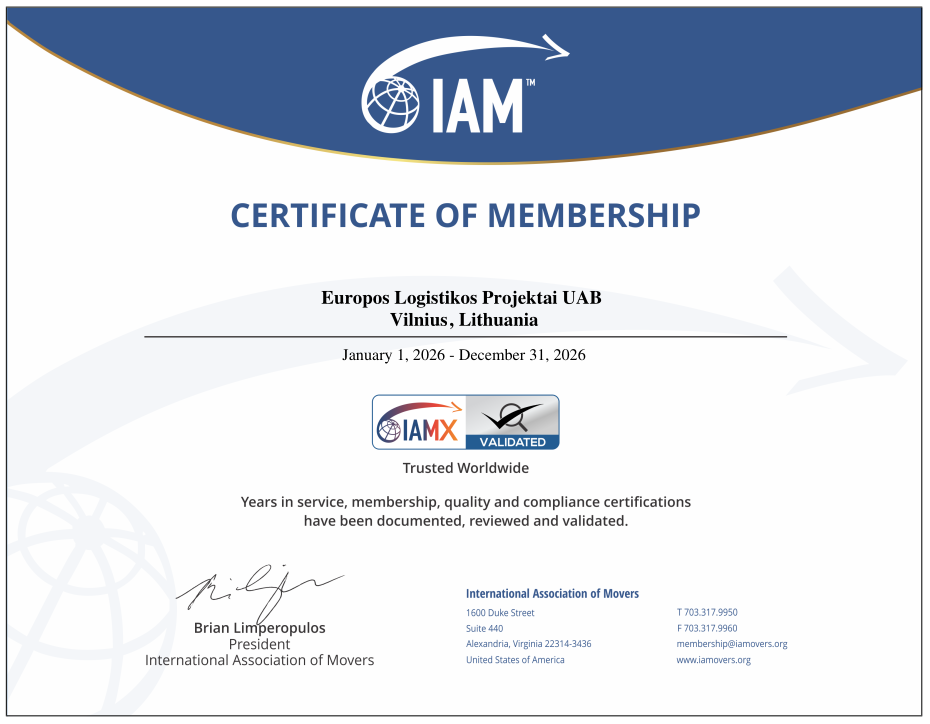
Our membership in international moving organizations guarantees the highest standards of service and reliability. We work with a global network of partners to ensure the smooth and safe transportation of your belongings in any direction.




Why choose us?
Working with us will ensure:
- Timely delivery of your belongings, so you can be sure that they’ll arrive when you need them.
- Expert handling of customs procedures, ensuring that your move is free from unexpected problems or delays.
- No wasted time, as we work efficiently to make sure that your move is completed as quickly as possible.
- No unnecessary financial losses, thanks to our competitive pricing and careful management of your move.
Our prices depend only on the volume of your belongings.
Forget about hourly rates, mileage calculations and unexpected bills! We have already calculated prices for different quantities of belongings and provide them to you in advance. You will not have to worry about how many movers, cars or how long the move will take – just choose the right service package according to the volume of your belongings and get a clear and fair price.